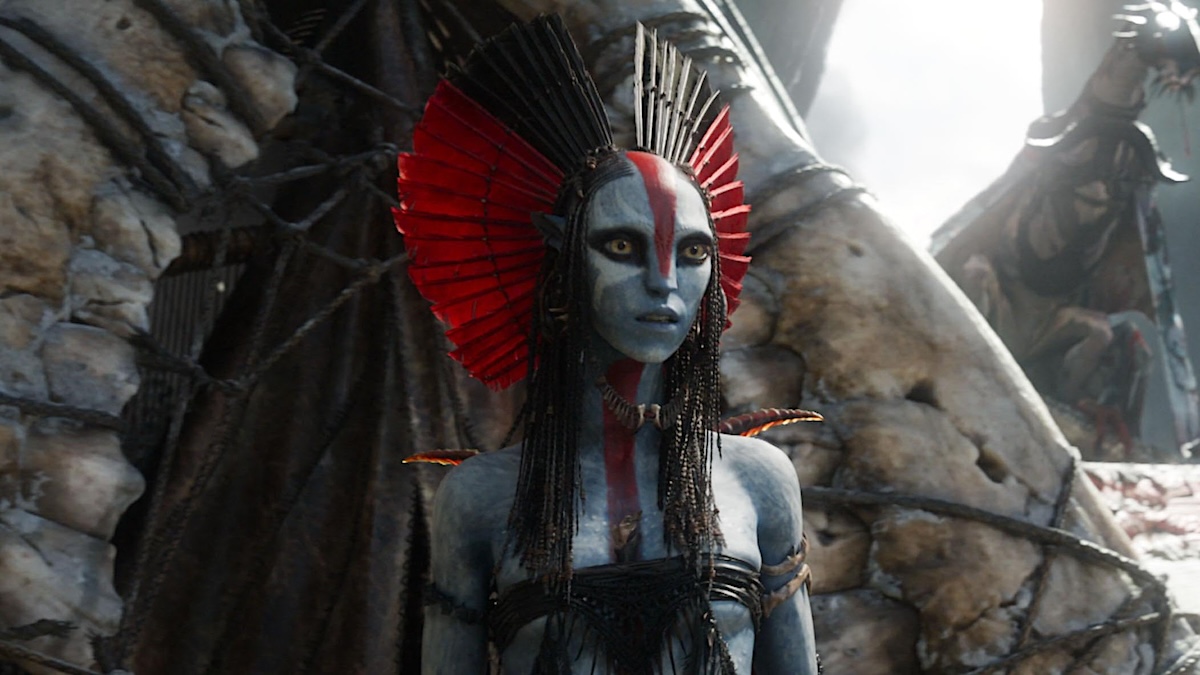
En AVATAR: FUEGO Y CENIZAS, los diseñadores de producción Dylan Cole y Ben Procter comparten la responsabilidad del aspecto general y el diseño de la película. Procter se encargó de todos los elementos del mundo humano y de la Tierra –incluidos entornos, vehículos y armas–, mientras que Cole estuvo a cargo de diseñar todo lo relacionado con Pandora y los na’vi.
“Tuvimos mucha suerte de que Jim y Jon nos convocaran —dice Procter—. Habiendo trabajado en la primera película como directores de arte conceptual, luego dividirnos las responsabilidades de diseño en AVATAR: EL CAMINO DEL AGUA, y hacerlo ahora de esta forma unificada fue, obviamente, un
10
enorme privilegio. Y esta vez tenemos algunos sets nuevos muy interesantes. Seguimos aumentando el tamaño y la complejidad de los sets, y tenemos un nuevo laboratorio, que se ve increíble y es diferente de los otros laboratorios que hicimos antes. Es un diseño de ciencia ficción realmente atractivo, con una cápsula para Spider, que se usa para estudiarlo a él, porque puede respirar el aire de Pandora. Lo tratan como a un animal de zoológico dentro de esta burbuja transparente, para poder observarlo en su entorno natural, y todos los técnicos médicos tienen que usar mascarillas porque no pueden sobrevivir dentro de esa cápsula… solo Spider puede”.
Procter continúa diciendo: “Fue una forma visual muy divertida de mostrar esta especie de fenómeno en el que se convirtió Spider con todas las transformaciones que atravesó. Y fue interesante replantearlo desde una perspectiva humana, muy práctica y muy ambiciosa, de tratar de desentrañar cómo funciona. A nadie le importa Spider. Para ellos es solo un sujeto de prueba, y lo que buscan es descubrir cómo seguir impulsando la colonización de Pandora. Este es uno de los pocos momentos en los que los mundos de diseño del lado de Dylan, lo orgánico y lo na’vi, y del mío, el de la RDA, realmente se encuentran”.
Con lo que más se divirtió Cole fue con los Comerciantes del Viento. “Estaba muy entusiasmado con este nuevo clan nómada —comenta el diseñador de producción—. Se ríen, bailan, hacen música, chismean y viajan, así que conocen muchos clanes distintos e interactuaron con ellos. Y tienen estas enormes góndolas, que básicamente son como naves tejidas, algo así como un pequeño poblado suspendido bajo lo que llamamos un medusoide, una criatura voladora gigantesca inspirada en una medusa y en la carabela portuguesa, que flota en el aire. Y a su vez es remolcada por otra criatura llamada windray, que está inspirada en una sepia, aunque también es enorme. Esta funciona como remolcador y guía de todo el sistema. Y no es solo una: son seis, que forman esta inmensa caravana maravillosa que viaja por los cielos de Pandora”.
“El segundo clan nuevo que conocemos en AVATAR: FUEGO Y CENIZAS, el Pueblo de las Cenizas, o los Mangkwan, sufrieron una tragedia en su pasado reciente y, como consecuencia, se dedicaron a atacar y esclavizar a otros clanes —dice Cole—. No son gente agradable. Y lo interesante es que esto le da más profundidad a la franquicia, porque ya no es tan simple como «los na’vi son buenos, los humanos son malos». Ahora hay una complejidad de pueblos, así que realmente se trata de esa complejidad y de las decisiones que toma cada uno. Su hogar quedó destruido por un volcán y, en lugar de irse, renunciaron a Eywa y dijeron: «No nos vamos. Este es nuestro hogar». Así que establecieron su casa en el tronco quemado de su Árbol Madre, que es un árbol negro, carbonizado, un remanente maltrecho de su pasado”.
Y continúa diciendo: “Se ven fragmentos caídos, y también la cantidad de ceniza que hay, con los troncos de los árboles sepultados por todas partes. Desde entonces ellos construyeron estructuras para habitar ese lugar como un poblado. Lo importante que hay que recordar sobre el Pueblo de las Cenizas, y que para nosotros fue clave tener presente, es que siguen siendo na’vi. No son hombres de las cavernas primitivos. Son inteligentes y excelentes artesanos. Solo tienen un enfoque diferente, así que su arquitectura debe ser igual de impresionante. Su tótem también tenía que ser ornamentado. Pero ese talento artesanal lo aplican usando huesos y calaveras, y los cuernos, dientes y pieles de animales, lo que le da un aspecto aún más crudo e impactante”.
11
~ EL FANTÁSTICO DISEÑO DE VESTUARIO ~
“El desafío para Deb fue idear propuestas de diseño que ella construiría en el mundo real pero que solo se terminarían de materializar en el mundo digital. Y, al mismo tiempo, saber cuándo tenía que crear algo para la captura de movimiento que representara la ropa que alguien usaría en el mundo generado por computadora.” —Jon Landau
Deborah L. Scott contribuye a ampliar aún más el mundo vibrante e inmersivo de Pandora. Para este capítulo, Scott y su equipo volvieron a ampliar los límites del diseño de vestuario, dedicando años a desarrollar intrincadas telas, bordados con mostacillas y con hilos de bordar, y fusionando la artesanía tradicional con innovaciones digitales de vanguardia. El resultado sigue dando vida a los na’vi con una cultura ricamente detallada, inspirada en tradiciones artesanales indígenas y materializada a través de miles de piezas de vestuario y elementos de utilería hechos a medida.
Aunque todo el vestuario de los na’vi diseñado por Scott fue luego materializado digitalmente en pantalla por los artistas de Wētā FX, todo se fabricó como objetos reales y tangibles, incluyendo todas las joyas y accesorios.
Para AVATAR: FUEGO Y CENIZAS, Scott tuvo que diseñar el vestuario de dos clanes nuevos, comenzando con los Comerciantes del Viento, liderados por Peylak (David Thewlis). “De todos los clanes que diseñé hasta ahora, el de los Comerciantes del Viento fue el más fácil —dice la galardonada diseñadora de vestuario—. Y creo que es porque ya comprendía el lenguaje de Pandora, pero también porque Jim fue muy claro al indicar que estas personas son nómadas que viajan por el cielo, donde hace frío, lo cual era algo nuevo para Pandora, así que tuvimos que hacer ropa para ellos”.
Scott continúa diciendo: “Los Comerciantes del Viento hacen su propia ropa, tejen a mano y les gusta arreglarse, así que verán muchísimos accesorios y muchas piezas talladas a mano, pero es porque tienen acceso a una enorme variedad de materiales, ya que compran y venden mientras viajan. No sabemos de dónde provienen los objetos porque tampoco sabemos exactamente por dónde anduvieron. La idea detrás del diseño era que tuvieran casi demasiados accesorios, y que uno pudiera acercarse a uno de ellos y decirle: «Oye, ¿me vendes ese collar?». El aspecto comercial es muy importante para Jim”.
“Ellos obedecen las normas de Eywa —explica Scott—. No usan metal ni trabajan piedra contra piedra, pero mantienen los mismos principios que ya vimos en la población de Pandora. Son alegres y coloridos, así que me enfoqué mucho en colores intensos, quizá los colores del cielo nocturno, que es una combinación de tonos muy vibrante. También escalan, son gente muy activa”.
Para el Pueblo de las Cenizas, liderado por Varang (Oona Chaplin), Scott imaginó que la pintura corporal sería su principal forma de expresión, lo que implicaba que todo lo demás sería mínimo. “La actuación de Oona es muy física —comenta Scott—. Tiene una presencia corporal bellísima. Al principio se suponía que usaría lo mismo durante toda la película, pero ahora tiene seis o siete cambios, que en nuestro mundo es muchísimo. Lleva mucho tiempo diseñarlos, porque confeccionamos y luego reconstruimos en el mundo digital. Realmente le aporta a su personaje lo que se merece”.
12
El Pueblo de las Cenizas vive en un entorno árido y cubierto de ceniza. Infligen dolor a otros y ellos mismos no sufren el dolor. Tienen muchas cicatrices y muchísimos piercings. “En ellos todo es negro y rojo, lo que les da un aire misterioso, pero el rojo no está pensado como sangre… es un rojo extremadamente oscuro” —explica Scott—.
Y continúa diciendo: “No se ve mucho rojo en Pandora. El único otro rojo que realmente usamos fue con Mo’at, la madre de Neytiri, porque era un color que indicaba su estatus dentro del clan Omatikaya como su Tsahik, y con Ikeyni, que formaba parte del clan Tayrangi, otro clan que exploramos en la primera película. Ella usaba un rojo más parecido al óxido. Pero queríamos que Varang realmente se destacara, y es sumamente impactante con su rojo intenso, su negro intenso y su magnífico tocado”.
Scott comenzó a diseñar los vestuarios para los Comerciantes del Viento y el Pueblo de las Cenizas en 2017, y desde entonces realizó más de 8.000 ilustraciones. Para los Comerciantes del Viento confeccionó 333 muestras de vestuario, y para el Pueblo de las Cenizas, 306. Se confeccionaron 387 piezas de vestuario para los personajes principales y más de 400 artículos para los vestuarios de acción real en estilo na’vi, que incluyeron 241 taparrabos.
~ EL REVOLUCIONARIO TRABAJO DEL EQUIPO DE MONTAJE ~
“El camino creativo de cualquier película es que la propia película te dice lo que necesita ser. No es algo que se reciba desde lo alto. Se recibe en el sentido de que adquiere vida propia. Los artistas, los que crean a las criaturas, los actores… todos aportan a esta gran especie de caldo creativo. Y mi trabajo es acompañarlo a través del proceso de montaje hasta convertirlo en algo terminado.” — James Cameron
El montaje en AVATAR: FUEGO Y CENIZAS es uno de los pilares de la producción. No es solo un pilar de la posproducción, sino de la producción, ya que el equipo de montaje –integrado por los montajistas Stephen Rivkin, Nicolas de Toth, John Refoua, Jason Gaudio y James Cameron– participa en el proceso desde la preproducción hasta la posproducción.
Según el productor Jon Landau: “Primero hacen juntos el montaje del material preliminar de previsualización y, cuando iniciamos la captura de actuaciones, hacen la primera de muchas versiones distintas del montaje de una escena, lo que llamamos montaje de actuación. Ahí revisan las cámaras de referencia filmadas el mismo día de la captura de actuaciones y arman las escenas con lo que consideran las mejores interpretaciones. A veces se combinan actuaciones de una sola toma y otras veces se elige una toma de Sam y otra de Zoe, por ejemplo, y se busca que encajen sin que se note. Luego tienen que preparar todo ese material para lo que llamamos paquetes de cámara, y después Jim sale a filmar con sus cámaras virtuales”.
“Lo realmente inusual —continúa diciendo Jon Landau— es que, en ese momento, siempre hay un montajista presente en el set que recibe la toma en vivo mientras se filma, y empieza a trabajar con ese material, de modo que Jim recibe retroalimentación directa durante ese proceso. Una vez que se filman las cámaras virtuales, recién ahí tenemos las tomas del día, y ahí es la primera vez que pueden sentarse a hacer el montaje de una escena. Para hacerlo necesitan saber cómo encaja dentro de la historia en su conjunto. No solo lo que estamos filmando en ese momento, sino la historia completa”.
13
Y continúa diciendo: “Recibimos las tomas del día de la captura de actuación, y suelen consistir en una matriz de muchas cámaras, entre dos y 16. Todos los días, analizamos las actuaciones después de revisarlas cuidadosamente con Jim y armamos los montajes de actuación. Pero aquí es donde empieza todo. En algo como esto es donde ves a varios personajes siendo capturados al mismo tiempo”.
Según Stephen Rivkin: “Lo que hacemos es tomar estos fragmentos junto con una pantalla superior donde tenemos lo que llamamos la cámara A. Esa es la cámara que Jim usa para bloquear la escena durante la captura. Nos da una idea del entorno y de dónde están los personajes en el espacio. Armamos un montaje de actuación, que incluye muchas cosas provenientes de distintas tomas, y todo eso se reproduce junto para analizar cómo se construirá finalmente la escena. Todo esto se incorpora en los paquetes de cámara, que luego se procesan en conjunto, donde todos los elementos capturados se combinan en un archivo listo para filmar. En ese punto, pasa al estudio para control de calidad, y le ponemos una cámara para corregir defectos, una cámara virtual que es capaz de leer ese archivo”.
Rivkin continúa diciendo: “Usamos un RCP, o proceso de pase de cámara preliminar, que dirige Richard Baneham (supervisor de efectos visuales de Lightstorm) junto con el editor Jason Gaudio, en el que verificamos los paquetes de cámara y armamos un primer pase de cámara preliminar de esos paquetes. Puede haber muchos paquetes que conforman una escena, y con todos ellos tenemos que encontrar puntos donde estemos conformes con los cortes de paquete. Los cortes de paquete son momentos en los que una sección llega hasta cierto punto, luego hay otra construcción para la segunda parte, y otra más para la tercera. Y todos estos cortes de paquete los aprueba Jim para asegurarse de que no tengamos nunca un plano continuo que dependa de dos paquetes distintos. Siempre debe haber un plano intermedio que conecte un paquete con el siguiente”.
~ PERFECCIONAR EL ARTE DE LA CAPTURA DE ACTUACIÓN ~ “Las actuaciones tienen que ser auténticas, y ese es el gran poder de estas películas. Sabemos que estos personajes son imposibles. La gente no tiene orejas así,
ni los ojos tan grandes. No tiene cuellos tan largos ni colas ni todas las
características de un na’vi, pero aun así los vemos como si existieran. ¿Y por qué nos dejamos convencer por la sensación de que son personas reales? Es por ese espíritu,
ese mantra que seguimos todos los días: honrar la actuación
por encima de todo”. –James Cameron
Para capturar una escena se utiliza un sistema de cámara virtual. Los actores trabajan en un “volumen”, ya sea realizando captura de interpretación “en seco” en un set de sonido o en un enorme tanque de agua capaz de registrar actuaciones bajo el agua. Los actores tienen marcadores en el cuerpo y arneses con dos cámaras de alta definición en la cabeza para capturar el cien por ciento de su actuación en el mundo digital.
“Las películas de la franquicia AVATAR no se hacen con computadoras —dice Cameron, director, coguionista y productor—. Se hacen con un equipo increíblemente talentoso de personas, especialmente nuestros actores, que realizan físicamente cada escena. Trabajé con mi elenco en AVATAR: EL CAMINO DEL AGUA y AVATAR: FUEGO Y CENIZAS durante casi 18 meses. Cada expresión,
14
cada movimiento, cada matiz emocional proviene de sus actuaciones reales. Y una vez que tenemos eso capturado, nuestros artistas trabajan incansablemente para dar vida a esos personajes, y a todo ese mundo”.
Hablando sobre el papel del actor en un set de cámara virtual, Sam Worthington dice: “Básicamente llevas un traje y una máscara con puntos, que son capturados por cientos de cámaras infrarrojas. Todo lo que haces, todo lo que dices, todo lo que sientes, hacia donde miras, cómo eres, se traduce mediante esos puntos al sistema. Ya seamos los actores o un doble de acción saltando al agua, volando sobre una criatura o llorando por la muerte de un hijo, siempre somos nosotros, todo es real. Y cuanto más mejoró la tecnología, más sutiles pudimos ser en nuestras actuaciones. Así que incluso si estoy simplemente parado, respirando y pensando, eso se va a traducir a través del sistema, y a mi actuación no se le añade nada”.
El hecho de que la tecnología de captura de interpretación esté impulsada por los actores es la fuerza impulsora detrás de las películas de la franquicia AVATAR, y su éxito suele atribuirse al uso pionero de esta técnica, que permite que el mundo ficticio y sus personajes literalmente cobren vida. Se trata de una técnica que utiliza los movimientos y las expresiones faciales para dar vida a personajes generados por computadora que además tienen una apariencia fotorrealista. En cada una de las películas de la franquicia, esto fue fundamental para dar vida a los na’vi y otras criaturas fantásticas.
Cameron y su talentosísimo equipo utilizan tecnología de última generación para trasladar las expresiones y toda la corporalidad de los actores al mundo digital de Pandora. Al capturar los sutiles matices emocionales y los movimientos de los intérpretes, esta tecnología permite crear personajes de apariencia real, lo que potencia la experiencia inmersiva del público. Cada detalle de las interpretaciones físicas y faciales de los actores se refleja fielmente en sus contrapartes digitales, de modo que hasta el más mínimo gesto se traduce con precisión en estos fantásticos personajes alienígenas generados por computadora.
“Todo, desde los momentos dramáticos más íntimos hasta nuestras escenas de riesgo más espectaculares y los movimientos bajo el agua, se hace de verdad, es acción real —explica el coproductor Jamie Landau—. En el pasado se creía equivocadamente que estas películas eran animadas, cuando en realidad no lo son. De hecho, estuvimos haciendo captura de interpretación durante 18 meses”.
Jon Landau explica: “Jim Cameron escribió AVATAR en 1995. En ese momento no existía la tecnología necesaria para contar la historia de la forma en la que queríamos hacerlo. Cuando le digo eso a la gente, muchos piensan que hablo del 3D, pero no tiene nada que ver con el 3D. Lo que se buscaba era mostrar en pantalla personajes con emocionen y cautivadores usando efectos generados por computadora. Entonces, el desafío era cómo generar, para un director como Jim Cameron, la misma intimidad que se tiene al trabajar con un elenco, pero con personajes generados por computadora que habitan el mundo de Pandora. Esa tecnología no existía. Analizamos lo que la gente hacía con lo que llamaban captura de movimiento, y era prometedor, pero le faltaba un elemento clave, que era la captura de la emoción. Luego la transformamos en captura de interpretación cuando empezamos a registrar la actuación facial al mismo tiempo que la corporal. Después la convertimos en producción virtual: pusimos una cámara
15
en las manos de Jim Cameron y él podía ver al personaje, no a la persona que estaba frente a él, sino a su personaje na’vi o su avatar. Y cuando miraba el escenario vacío en el que trabajábamos, no veía un escenario vacío, veía el mundo de Pandora. Se había convertido en una herramienta cinematográfica dentro de un proceso profundamente centrado en la actuación. Eso no existía. Tuvimos que crear todas las tecnologías necesarias para hacerlo posible”.
Y continúa diciendo: “Cada vez que hacemos captura de interpretación, filmamos material de referencia de los actores. A veces grabamos con hasta 16 cámaras al mismo tiempo. Ese material de referencia lo usan primero los montajistas, para poder ver las actuaciones. Dividen la pantalla en dieciséis cuadrantes, donde se ven las dieciséis imágenes, y luego amplían una de ellas para observar la sutileza de la actuación y así elegir las mejores tomas. Ese material de referencia se mantiene entre bastidores durante todo el proceso. Cuando entregamos una plantilla a nuestros visionarios colegas de Wētā, les damos ese material de referencia, y cuando ellos empiezan a trabajar en la animación, colocan esa referencia en una imagen dentro de la imagen durante todo el proceso, para asegurarse de que el personaje animado reproduzca con precisión lo que el actor hizo ese día”.
“En este momento, nadie hace un mejor trabajo de acabado de la captura de efectos visuales que Wētā, y eso se debe a la relación constante de retroalimentación entre la producción y el estudio de efectos visuales, tanto en lo tecnológico como en lo creativo —explica Sanchini—. Y hemos desarrollado una especie de lenguaje compartido. A veces es difícil explicar exactamente por qué una toma no funciona, por qué un rostro no se ve natural o por qué no se mueve de la manera correcta, y nos llevó años desarrollar ese lenguaje común para que todos vieran lo mismo y supieran cómo resolverlo. Y en esta película, todos hablan el mismo idioma, en todo momento”.
Cameron y el equipo de montaje seleccionan las mejores interpretaciones para cada momento de una escena determinada y luego utilizan una cámara virtual para crear los planos específicos. La cámara virtual le permite a Cameron filmar escenas dentro del mundo generado por computadora como si estuviera rodando en una locación real o en un set. Con esta cámara virtual, él ve a los actores como sus personajes azules de casi tres metros de altura, en Pandora.
~ EFECTOS VISUALES DE ÚLTIMA GENERACIÓN ~
“A menudo, la gente piensa en las distintas etapas de una producción como preproducción, producción y posproducción. En las películas AVATAR, esas líneas están completamente desdibujadas, y nuestro proceso de efectos visuales empieza en la preproducción”. –Jon Landau
Una vez que las tomas de la cámara virtual se montan en secuencias, los planos y las actuaciones se entregan a los expertos en efectos visuales de Wētā FX, la compañía de efectos visuales de Peter Jackson en Nueva Zelanda, ganadora en los premios Oscar®. En AVATAR: FUEGO Y CENIZAS hay 3.382 planos de efectos visuales.
Bajo la dirección del supervisor senior de efectos visuales Joe Letteri, que desarrolló muchas de las técnicas que hoy son estándar en la industria para crear efectos digitales fotorrealistas, la tecnología ha avanzado a pasos agigantados. “Cuando empezamos a trabajar en AVATAR, la forma en que hacíamos los efectos visuales era mucho más primitiva —comenta Joe Letteri—. Pero seguimos perfeccionando todo lo que necesitábamos para crear estos mundos. Hay que llenar estos mundos de personajes
16
creíbles. Hay que crear entornos con plantas alienígenas. Hay que crear cielos, atmósferas y criaturas, lo cual era fantástico, porque nos permitió pensar en cada aspecto que interviene en la creación de un mundo. Tuvimos que plantearlo todo desde cero y pensar cómo construirlo, y eso fue la base de todo lo que hicimos después y nos dio una plataforma para reinventarlo”.
“Nuestra mayor evolución siempre se produce con la tecnología facial —continúa diciendo Letteri—. Avanzamos muchísimo desde la forma en la que lo hicimos para AVATAR: EL CAMINO DEL AGUA, y seguimos perfeccionando el sistema en esta película. Nuestra gran innovación fue desarrollar una forma de construir y utilizar una red neuronal que entendiera el movimiento del rostro y que nos ayudara a generar un movimiento más realista. Hicimos la primera versión para AVATAR: EL CAMINO DEL AGUA y después nos tomamos un tiempo para ver cómo podíamos mejorarlo, sobre todo en cuanto a darles a los artistas una manera más sencilla de hacer su trabajo. Porque los pequeños toques creativos que los artistas deben aportar no pueden ser resueltos por un sistema matemático. Ellos necesitan herramientas para hacer su trabajo, y en eso fue en lo que realmente nos enfocamos con esta película. Y, con suerte, ese plus de inversión emocional se nota”.
Richard Baneham, de Lightstorm, trabaja en estrecha colaboración con Letteri. “Una de las cosas más difíciles en el área de los efectos visuales es la comunicación con el director… tener que explicar lo que uno quiere lograr —dice Baneham—. El resultado de todo lo que mencionamos, el proceso virtual, es una plantilla. Hay que pensarlo como una manera de montar la película en una versión que todavía no está totalmente terminada, pero que está muy cerca de la intención que buscamos: tanto en el lenguaje de cámara, como en las decisiones específicas sobre qué actuaciones de los actores van a quedar en el archivo, cuál es el movimiento de la criatura y cómo afecta la escena, y los efectos”.
Baneham continúa diciendo: “Eso da como resultado algo que no es la película final, pero tampoco es una previsualización. Es una visualización intermedia muy avanzada, como decía Jon, esla película, solo que aún falta llevarla a un nivel mucho más realista. Las particularidades específicas de la actuación facial, la musculatura de los cuerpos y de las criaturas, y la interacción con las plantas. Esas son las cosas que no están en nuestra plantilla. Pero tenemos algo que está muy cerca de ser totalmente mirable”.
Ese modelo preliminar luego pasa a manos de Wētā y se convierte en una guía para Cameron. “Solo hay que seguir el modelo —dice Baneham—. Y creo que eso ahora es un poco más sencillo gracias a la confianza que se generó con el equipo con el que venimos trabajando… y tuvimosla suerte de colaborar con el mismo grupo de artistas durante mucho tiempo. Y cuando se incorporan nuevos artistas, ya existe una cultura de trabajo, y la adoptan muy rápido. Pero ese modelo expresa la intención exacta de la escena, y aunque no sea el producto final, respetar lo que está ahí, sobre todo su valor narrativo, y prestar atención al detalle… creo que eso es lo que nos permitió tener una relación de trabajo tan buena con Wētā, con ILM y con los demás equipos”.
Daniel Barrett, supervisor senior de animación en Wētā FX, trabaja en estrecha colaboración con Baneham para supervisar todo lo que se mueve en la película, excepto los efectos. “Estoy involucrado desde el principio y luego vuelvo a intervenir un poco más adelante, cuando los planos ya están creados en ese formato de modelo preliminar —explica Barrett—. Jim es muy minucioso a la hora de concebir el ecosistema y el entorno de Pandora. Las criaturas son alienígenas, pero no fantásticas. Puedes mirar
17
a cualquiera de ellas e inferir más o menos su camino evolutivo y la mecánica de cómo se mueven. Y eso es algo en lo que nos involucramos desde muy temprano”.
Y continúa diciendo: “El equipo de dirección de arte crea criaturas increíbles para nosotros, y después tenemos un equipo más pequeño de animación que trabaja en viñetas. Luego desarrollamos esa animación hasta un nivel bastante avanzado, y el laboratorio la retoma para integrarla en las escenas. Después, Jim crea los planos con las cámaras. Filma esa animación con cámaras y luego se construyen los planos y, cuando volvemos a ver ese material, ya está en una versión preliminar de plantilla, con los planos completamente establecidos”.
Eric Saindon, que trabaja para Wētā desde los Stone Street Studios en Wellington, cuenta que el proceso se volvió completamente fluido, sobre todo gracias a la sólida relación entre Wētā y Lightstorm. “Es una colaboración que ha ido evolucionando de película en película —explica—. Estas plantillas son básicamente una versión simple de la película, para que podamos entender cómo van a ser las escenas. En la primera película, Lightstorm nos enviaba archivos y teníamos que hacer grandes conversiones para incorporarlos a nuestro sistema y que funcionaran, pero en AVATAR: EL CAMINO DEL AGUA todo se volvió mucho más fluido. Desarrollamos muchos flujos de trabajo que nos permitieron incorporar una plantilla o un archivo de cámara, en donde Jim filmaba con sus cámaras y hacía la captura de interpretación, e integrarlo en nuestro sistema. Ahora podemos llevar archivos de Lightstorm a Wētā y viceversa. Así que, si Jim necesitaba algo con una animación ligeramente distinta porque incluía personajes para los que no se puede hacer captura, nosotros animábamos ese material y se lo enviábamos de vuelta a Lightstorm”.
El mayor desafío para Saindon y su equipo fue crear el agua, o más específicamente, lograr que el agua tuviera la escala correcta. “El agua es complicada —explica Saindon—. Porque siempre se comporta de manera distinta. Así que invertimos mucho esfuerzo en nuestro sistema de efectos para que el agua, y el fuego, fueran realistas, que el público los viera como reales. Desarrollamos un sistema que nos permite hacer simulaciones de un nivel realmente muy alto”.
~ LA MÚSICA: EL CORAZÓN DE LA PELÍCULA ~
“No conozco ninguna otra película en la que el compositor, la diseñadora de vestuario y el equipo de diseño de producción se sienten juntos en una misma sala para definir la cultura de los distintos clanes que imaginó Jim Cameron. Nosotros tenemos que definirlos. Y mi propuesta musical, que establece la identidad cultural de esos clanes,
tiene que conectarse con la visión de vestuario de Deb Scott y con el diseño
de producción de Dylan Cole”. –Simon Franglen
Simon Franglen vuelve a AVATAR: FUEGO Y CENIZAS tras componer la música de AVATAR: EL CAMINO DEL AGUA. Para esta película, Franglen creó música nueva, inspiradora y emocional, pero que mantiene una conexión con AVATAR (2009), cuya banda sonora estuvo a cargo del legendario James Horner. Incluso creó nuevos instrumentos para que tocaran los Comerciantes del Viento.
“Simon nos demostró que era la persona indicada después de componer la música de Pandora en el Animal Kingdom de Disney en Orlando —dice el productor Jon Landau—. Cuando la gente baja de una
18
atracción y llora, no es solo por la experiencia visual sino por los temas que compuso Simon y que la gente está escuchando”.
Al hablar de los cambios narrativos que enfrentan los personajes en esta película, Franglen dice: “Hay un giro dramático en la emoción, así que la música tiene que reflejar ese cambio. Obviamente, conocemos personajes y clanes nuevos, como los Comerciantes del Viento, que necesitaban su propio tema. Es muy impresionante visualmente cuando aparecen por primera vez. Y con el Pueblo de las Cenizas y su apariencia, así como la razón detrás de esa apariencia, era esencial transmitir eso a través de la música. Esta es una película más profunda en muchos sentidos, y en varios momentos más oscura, así que necesitaba crear nuevas texturas, elementos musicales distintivos, además de temas para los personajes nuevos”.
“Jon Landau solía decir que la música es el corazón de una película —continúa diciendo Franglen—. Y una de las maravillas de la serie de películas AVATAR, en cuanto a lo musical, es que tengo la enorme ventaja de trabajar con un director que ama la música. Él entiende su poder y sabe lo crucial que es para contar una historia. Le importa cada nota que escribo, lo que significa que a veces tengo que reescribir cosas hasta que él está absolutamente seguro de que logré exactamente lo que necesitaba. Y eso es algo muy bueno, porque hace que mi música sea mejor. Siento que sus comentarios, ese ida y vuelta que tenemos, siempre mejoran la banda sonora. La música está para darnos una conexión emocional. Hay algo curioso que pasa en el cine, y es que se puede medir cómo los ritmos cardíacos del público se sincronizan con lo que ocurre en pantalla”.
Miley Cyrus, artista pop ganadora en los premios GRAMMY®, grabó una canción nueva para AVATAR: FUEGO Y CENIZAS titulada “Dream as One”. La canción está interpretada por Miley Cyrus, con música y letra de Cyrus, Andrew Wyatt, Mark Ronson y Simon Franglen. Esta balada aparece en los créditos finales y también forma parte de la banda sonora original de la película.
~
AVATAR: FUEGO Y CENIZAS estrena exclusivamente en cines de todo el mundo en IMAX 3D, Dolby Cinema 3D, RealD 3D, Cinemark XD, 4DX, ScreenX y pantallas premium el 19 de diciembre de 2025.
“Sin duda esta es una película de aventuras —dice Cameron, director, coguionista y productor—. Es una película de acción. Pero también puede tener un mensaje, y creo que en este momento necesitamos salir, y parte de nuestro entretenimiento y de nuestro proceso de disfrute al ir al cine debería ser usar la aventura, la acción, la emoción y lo fantástico para procesar en un momento cómo nos sentimos en general”.
~ ABOUT THE CAST ~
SAM WORTHINGTON (Jake) is an acclaimed Australian actor whose career spans epic blockbuster films, such as “Avatar,” “Terminator: Salvation,” and “Clash of the Titans,” as well as acclaimed independent films like “Somersault.” He graduated from Sydney’s prestigious National Institute of Dramatic Art (NIDA) and made his feature film debut with the Australian film “Bootmen,” which earned
19
him an Australian Film Institute (AFI) Award nomination for best performance by an actor in a leading role in 2000. Nine years later, Worthington debuted the role he’s become best known for, Jake Sully, in James Cameron’s Oscar®-winning franchise “Avatar.”
After an extensive casting search, Worthington was cast by James Cameron as the lead role in “Avatar”—Cameron’s first narrative film since his 1997 Oscar®-winning blockbuster “Titanic.” The film received several nominations for the 2010 Academy Awards®, including best picture, and won the Golden Globe Award® for best motion picture – drama. The second installment, “Avatar: The Way of Water,” was met with equal praise and went on to receive four Oscar nominations in 2023. Sixteen years after its release, “Avatar” remains the No. 1-grossing film of all time at over $2.9 billion worldwide, and “Avatar: The Way of Water” remains at No. 3 on the list. The highly anticipated third installment, “Avatar: Fire and Ash,” premieres theatrically on December 19, 2025.
Also upcoming, Worthington will star in David Mackenzie’s “Relay” with Riz Ahmed and Lily James, Alejandro Monteverde’s “Zero A.D.” with Gael Garcia Bernal and Ben Mendelsohn, David Mackenzie’s “Fuze” with Aaron Taylor-Johnson, and Netflix’s new Harlan Coben series “I Will Find You.”
Additional film credits include Oscar®-nominated “Hacksaw Ridge,” “Lift,” “Horizon,” “The Killer” (2024), “Fractured,” “The Shack,” “Everest,” “Cake,” “The Debt,” “Last Night,” “Clash of the Titans,” “Wrath of the Titans,” “Terminator: Salvation,” and Australian films “Dirty Deeds,” “Getting’ Square,” “Hart’s War,” “The Great Raid,” along with Cate Shortland’s critically-acclaimed and commercially successful “Somersault,” for which Worthington won an AFI Award for best actor in a leading role.
On the television side, Worthington received great notices for his nuanced lead performance in the limited series “Manhunt: Unabomber,” opposite Paul Bettany. Most recently, he starred in the FX limited series “Under the Banner of Heaven,” executive produced by Dustin Lance Black, Ron Howard, Brian Grazer, and Jason Bateman. The series went on to be nominated for a Critics’ Choice Award for best limited series.
ZOE SALDAÑA (Neytiri) has steadily earned a reputation as one of the most versatile and respected powerhouses in the industry with a remarkable career spanning more than 20 years as an actor and producer. As an Academy Award®-winning actress and the only actor in history to have starred in four films that have grossed over $2 billion and the top three highest-grossing films of all time, “Avatar,” “Avatar: The Way of Water,” and Marvel Studios’ “Avengers: Endgame,” Saldaña’s passionate commitment to seeking compelling, indelible roles has remained constant.
Saldaña will next reprise her role of Neytiri in the third installment of the Oscar®-winning “Avatar” franchise — “Avatar: Fire and Ash,” in theaters December 19, with two additional installments to follow. 2022’s “Avatar: The Way of Water” shattered box office records, including becoming the first pandemic-era film to reach $2 billion at the global box office and securing its spot as the third highest
grossing film of all time, following the first ‘Avatar” film from 2009, which remains at the top of the list.
She most recently starred in Netflix’s Oscar®-nominated Spanish-language musical crime comedy from Jacques Audiard, “Emilia Pérez.” Saldaña won the Academy Award® for best supporting actress at the
20
2025 Oscars for her role as Rita in the film, in addition to a Golden Globe®, Critics' Choice, SAG®, and BAFTA Award for the same category.
This year, she was also featured as a voice in Pixar’s animated cosmic misadventure film “Elio,” and led Marco Perego’s critically acclaimed and Oscar®-qualifying short film “Dovecote,” which follows a woman's final moments before her release from a seaside prison in Venice. The short film made it onto the 2025 Oscars shortlist and was selected for the 60th Venice Biennale as part of the Vatican Pavilion.
She is currently in production on season three of Taylor Sheridan’s undercover CIA drama series for Paramount+ “Lioness,” where she leads a fantastic cast, including Nicole Kidman and Morgan Freeman, as well as serves as executive producer. Season one launched in July 2023 and became one of the most watched global premieres on Paramount+, garnering nearly 6 million viewers combined on streaming and network television. The role has earned her a nomination for outstanding actress in a drama series at last year’s and this year’s NAACP Image Awards.
Past projects include Saldaña starring as trailblazing heroine, Nyota Uhura, in J.J. Abrams’ hit “Star Trek” franchise, beginning in 2009, and starring alongside Christian Bale, Casey Affleck, and Woody Harrelson in Scott Cooper’s 2013 crime thriller “Out of the Furnace.” In In 2014, she took on yet another iconic role with Gamora, the Marvel fan-favorite lethal alien assassin, in the blockbuster hit “Guardians of the Galaxy,” reprising the role in the 2017 and 2023 sequels “Guardians of the Galaxy Vol. 2,” and “Guardians of the Galaxy Vol. 3,” and again in the years to follow for “Avengers: Infinity War,” and “Avengers: Endgame.” In 2022, she starred opposite Ryan Reynolds, Jennifer Garner, and Mark Ruffalo in Shawn Levy’s “The Adam Project,” which remains on Netflix’s Top 10 most-viewed films of all time. That same year, Saldaña led Netflix’s limited series “From Scratch,” based on Tembi Locke’s best-selling memoir of the same name, which charted in Netflix’s Top 10 in 84 countries. She also starred in the 20th Century Studios’ mystery-comedy “Amsterdam,” directed by David O. Russell with an all-star ensemble including Christian Bale, John David Washington, and Margot Robbie.
In a career that began with a breakout role in the 2000 film “Center Stage,” Saldaña’s additional credits also include “Crossroads,” “Drumline,” “Pirates of the Caribbean,” “The Losers,” “Takers,” “Columbiana,” the NBC mini-series “Rosemary’s Baby,” and the Academy Award®-nominated animated feature “Missing Link.” She also lent her voice to the animated films “Book of Life” and “Vivo,” as well as the Netflix limited series “Maya and the Three.” She made her directorial debut in 2011 with the short film “Kaylien,” part of the Glamour Reel Moments series.
Saldaña has taken a very active role as a producer, forming Cinestar Pictures along with her sisters Mariel and Cisely, with an eye toward reshaping the American storytelling landscape with a commitment to diverse, character-driven narratives that reflect the authentic fabric of contemporary society. Championing honest portrayals of women and a true depiction of today's America, Cinestar produces compelling, multicultural stories for a global audience. The company’s first feature film was “The Honor List,” from Lionsgate Studio, was released in 2018. Since then, their projects have included the beloved hit family comedy series “The Gordita Chronicles” for Sony and HBO Max; the limited series “From Scratch” at Netflix with Hello Sunshine; two seasons of the Emmy®-nominated animal kingdom docuseries “Mamas” for Roku Channel; “Meet Me in Paris,” the first ever unscripted romantic comedy feature which quickly became the biggest Roku Original unscripted debut and the #1 reality title
21
premiere in the history of platform with the recently released second season, “Meet Me in Rome'”; the Disney+ series “MPower,” which spotlights several of the Marvel Cinematic Universe’s most inspirational women heroes; the Taylor Sheridan created spy-thriller series “Lioness” on Paramount+; the independent film “The Absence of Eden,” directed by Marco Perego and starring Saldaña; as well as the upcoming action-survival film for Amazon Prime Video, “The Bluff,” alongside the Russo Brothers. Cinestar also has projects in pre-production at Paramount, HBO, HBO Max, Disney+, and CBS.
In addition to her prolific acting and producing career, Saldaña founded BESE in 2018, a media company created to support and amplify the voices of the Latinx community by sharing real and untold stories of today’s America. The spirit of BESE’s mission extends to the partnership Saldaña launched with sportswear giant Adidas and Kohl’s department store in 2020. The activewear athleisure collections, ranging in sizes from XS to XXL, are meant to highlight, support, and celebrate women of color.
Saldaña received a star on the Hollywood Walk of Fame in 2018 and was honored with the outstanding achievement in film award by the National Association of Latino Independent Producers (NALIP) in 2017, for her impactful work to broaden representation of the Latinx community throughout Hollywood. She was recognized as one of TIME Magazine’s Most Influential People of 2023.
Born in New Jersey and raised in Queens and in the Dominican Republic, Saldaña currently resides in Los Angeles with her husband and three sons.
Three-time Academy Award®-nominated and BAFTA and Golden Globe®-winning actress SIGOURNEY WEAVER (Kiri) has created a host of memorable characters, both dramatic and comic, in films ranging from Ripley in “Alien” to Dian Fossey in “Gorillas in the Mist” to Gwen/Tawny in “Galaxy Quest.” Over the years, she has captivated audiences and won acclaim as one of the most versatile actresses on both stage and screen. In 2024, Weaver was awarded the Golden Lion for lifetime achievement at the 81st Venice International Film Festival as well as the International Goya Award at the 38th Spanish Academy Goya Awards for her decades-long career and contribution to cinema.
Born and educated in New York City, Weaver graduated from Stanford University and went on to receive a master’s degree from the Yale School of Drama. Her first professional job was in Sir John Gielgud’s production of “The Constant Wife,” working with Ingrid Bergman.
Weaver made her motion picture debut in Ridley Scott’s 1979 blockbuster “Alien.” She later reprised the role of Warrant Officer Ripley in James Cameron’s 1986 “Aliens”; her performance earned her Academy Award® and Golden Globe® nominations for best actress. In 1992, she again brought Ripley back to life in David Fincher’s “Alien 3,” which she also co-produced, and in 1997, she starred in and co-produced “Alien: Resurrection” for director Jean-Pierre Jeunet.
In 1988, Weaver portrayed primatologist Dian Fossey in “Gorillas in the Mist” and Katharine Parker in the Mike Nichols comedy “Working Girl.” Both performances earned her Academy Award® nominations, and she was awarded the Golden Globe® for best actress and best supporting actress in a motion picture. Next, she starred in the 1989 hit “Ghostbusters II,” directed by Ivan Reitman alongside Bill Murray and Dan Aykroyd. Other films include “The Year of Living Dangerously” (1982) with Mel Gibson and Linda Hunt, “Eyewitness” (1981) with William Hurt, “Half Moon Street” (1986)
22
with Michael Caine, Ridley Scott’s “1492: Conquest of Paradise” (1992), “One Woman or Two” (1985) with Gerard Depardieu, Roman Polanski’s gripping film adaptation of “Death and the Maiden” (1994), the thriller “Copycat” (1995), and Paul Rudnick’s comedy “Jeffrey” (1995). Weaver also starred in Showtime’s live-action film “Snow White” (1997), based on the original Grimm’s fairytale, which earned her an Emmy® nomination and a Screen Actors Guild® nomination.
In 1997, Weaver joined the ensemble of Ang Lee’s critically acclaimed film “The Ice Storm,” alongside Kevin Kline, Joan Allen, Elijah Wood, and Christina Ricci. Her performance garnered her a BAFTA Award, a Golden Globe® nomination, and a Screen Actors Guild® nomination for best supporting actress. She later gave a galvanizing performance in “A Map of the World” (1999), Scott Elliott’s powerful drama based on the novel by Jane Hamilton, which earned her universal critical praise and a Golden Globe nomination for best actress. Also in 1999, Weaver appeared in the science fiction comedy “Galaxy Quest,” directed by Dean Parisot, alongside Tim Allen and Alan Rickman. She delighted audiences with her flair for comedy, and the film proved to be a hit of the 1999 holiday season. She followed this with the popular comedy “Heartbreakers” (2001), opposite Gene Hackman and Jennifer Love-Hewitt.
In 2002, Weaver starred in the film version of “The Guys,” with Anthony LaPaglia, directed by Jim Simpson, and in 2003, she portrayed the cold-blooded, red-headed warden in the hit comedy “Holes,” directed by Andy Davis. The next year, Weaver appeared in M. Night Shyamalan’s “The Village” and received rave reviews for her performance in “Imaginary Heroes,” written and directed by Dan Harris.
In 2006, she appeared in “Infamous,” Jake Kasdan’s “The TV Set,” and “Snow Cake,” opposite Alan Rickman. In the following years, Weaver lent her voice to Pixar’s 2008 box office smash “WALL-E,” as well as “The Tale of Despereaux” (2008) with Matthew Broderick, Dustin Hoffman, and Emma Watson. She also starred in the Tina Fey/Amy Poehler comedy “Baby Mama” (2008) and Andy Fickman’s comedy “You Again” (2010). In December 2009, she starred in James Cameron’s groundbreaking film “Avatar,” which went on to become the highest-grossing film of all time. The film won the Golden Globe® for best picture and received an Academy Award® nomination for best picture.
Other credits include Drew Goddard’s “The Cabin in the Woods” (2012), Miguel Arteta’s “Cedar Rapids” (2011), “Paul” (2011), Amy Heckerling’s “Vamps” (2012), and Neil Blomkamp’s “Chappie” (2015). In December 2016, she starred in Focus Features’ “A Monster Calls,” alongside Liam Neeson, Felicity Jones, and newcomer Lewis MacDougall, followed by Lionsgate’s “Reassignment,” with Michelle Rodriguez, directed by Walter Hill in 2017.
In addition to her film credits, Weaver has also shone on stage. She started out on off-off Broadway in Christopher Durang’s “The Nature and Purpose of the Universe” (1974), “Titanic” (1976), and “Das Lusitania Songspiel” (1980). She and Durang co-wrote “Das Lusitania,” which earned them both Drama Desk nominations. She has appeared in numerous off-Broadway productions in New York, working with such writers as John Guare, Albert Innaurato, Richard Nelson, and Len Jenkin. In regional repertoire, she has performed works by Pinter, Williams, Feydeau, and Shakespeare. Weaver also appeared in the PBS mini-series “The Best of Families” (1977).
Weaver received a Tony Award® nomination for her starring role in “Hurlyburly” (1984) on Broadway, directed by Mike Nichols. She played Portia in the Classic Stage Company of New York’s production of
23
“The Merchant of Venice” (1986). In 1996, Weaver returned to Broadway in the Lincoln Center production of “Sex and Longing,” written by Christopher Durang. In Fall 2012, she starred in the Lincoln Center production of Christopher Durang’s “Vanya and Sonia and Masha and Spike,” which moved to Broadway in 2013. That year, “Vanya and Sonia and Masha and Spike” took home the Tony Award for best play.
Weaver originated the female lead in Anne Nelson’s “The Guys” (2001) at The Flea, where it was commissioned and directed by Jim Simpson. “The Guys” tells the story of a fire captain dealing with the aftermath of 9/11. In 2002, she starred in Neil LaBute’s play “The Mercy Seat,” opposite Liev Schreiber, which John Lahr of The New Yorker described as offering “performances of a depth and concentration that haven’t been seen in New York for many seasons.” Weaver also originated roles in two A.R. Gurney world premieres, “Mrs. Farnsworth” (2004) at the Flea Theater and “Crazy Mary” (2007) at Playwrights Horizons.
In television, Weaver received Emmy®, Screen Actors Guild®, and Golden Globe® nominations for her role as Mary Griffith in Lifetime’s “Prayers for Bobby,” which was also Emmy nominated for outstanding made-for-television movie. In 2012, she was seen in USA Network’s miniseries “Political Animals,” for which she received a SAG, Golden Globe, and Emmy nomination. Weaver also appeared in the Marvel series “The Defenders,” released globally on Netflix in August 2017.
Weaver was very proud to receive the GLAAD Media Award for her work in “Prayers for Bobby,” as well as the Trevor Life Award in 2011. She has been the honorary chair for the Dian Fossey Gorilla Fund for the last 33 years. She has also served on the Board of Human Rights First for 25 years and is currently a trustee on the Board of the New York Botanical Garden. Weaver was proud to receive the National Audubon Society’s Rachel Carson Award in 2009 for her environmental work. She was also a co-founder of The Flea Theater in Lower Manhattan, which championed young artists and new work and produced multiple New York Times critics’ choice shows.
Weaver appeared in season 4 of the French television series “Call My Agent,” which was released globally on Netflix in 2021 and won the International Emmy® for comedy series. Additionally, she starred in Philippe Falardeau’s “My Salinger Year,” which opened the 2020 Berlin International Film Festival. In April 2021, Weaver lent her voice to James Cameron’s “Secrets of the Whales,” which debuted on Disney+ and garnered an Emmy nomination for outstanding narrator. The series also won the Emmy® for outstanding documentary or nonfiction series. In 2022, Weaver starred in Phyllis Nagy’s drama film “Call Jane,” alongside Elizabeth Banks and Maya Forbes, as well as Wallace Wolodarsky’s “The Good House,” alongside Kevin Kline. That same year, she was seen in “Avatar: The Way of Water,” which was nominated for best picture at the 2023 Oscars®. In 2023, she starred in Paul Schrader’s “Master Gardener,” opposite Joel Edgerton, and Amazon Studios’ “The Lost Flowers of Alice Hart,” on which she also served as executive producer.
Most recently, Weaver made her West End debut starring in Jamie Lloyd’s adaptation of Shakespeare’s “The Tempest” at Theatre Royal Drury Lane and starred in “The Gorge” with Miles Teller and Anya Taylor-Joy. Up next, she will star in the black comedy “Dust Bunny,” alongside Mads Mikkelsen. Weaver is a New Yorker.
24
STEPHEN LANG (Quaritch) is an actor renowned for his performances on stage, screen, and television.
In film, Lang is perhaps best known for his role as Colonel Miles Quaritch in James Cameron’s seminal 2009 film “Avatar.” Lang reprised that role in Cameron’s highly anticipated sequel, “Avatar: The Way of Water,” and can be seen in the upcoming “Avatar: Fire and Ash,” out December 19.
Lang was recently seen in Amazon Prime Video’s biblical drama “House of David,” in which he stars as Samuel. Next up, he’ll be seen starring in Sony’s “Sisu: Road to Revenge,” out November 21.
In 2016, he starred to critical acclaim as The Blind Man in writer-director Fede Alvarez’s hit thriller “Don’t Breathe,” and he reprised his starring role in the film’s sequel, “Don’t Breathe 2.”
Recent film roles include “Barron’s Cove,” “Avenue of the Giants,” “The Lost City” for Paramount, with Sandra Bullock and Channing Tatum, and the much-anticipated “The Independent,” with Brian Cox, Jodie Turner-Smith, and Ann Dowd. Lang also completed work on “Pep,” based on the true story of Willie Pep, one of the greatest boxers of all time, in which Lang portrayed his trainer.
Other film credits include “The Seventh Day,” opposite Guy Pearce, director Joe Begos’ action-horror film “VFW,” “Braven,” opposite Jason Momoa, and director Scott Cooper’s “Hostiles,” opposite Christian Bale. Lang’s extensive film credits include “Band of Robbers,” “Last Exit to Brooklyn,” “Tombstone,” “Gettysburg,” “Gods and Generals,” “Public Enemies,” “White Irish Drinkers,” “Christina,” “A Good Marriage,” “Manhunter,” “Band of the Hand,” and “Conan the Barbarian.”
Lang is also an award-winning playwright. He received the special jury prize for acting at the 2016 Phoenix Film Festival for his performance documentary “Beyond Glory,” which tracks the ten-year odyssey behind his acclaimed solo performance piece about eight Medal of Honor recipients. The documentary was executive produced and presented by Lightstorm Entertainment principals, James Cameron and Jon Landau, and was acquired for distribution by Gravitas Ventures. “Beyond Glory,” the play itself, has received the NEA Chairman’s medal for distinguished service, and the Bob Hope Award from the Congressional Medal of Honor Society, which honors Lang’s accurate portrayal of the American fighting man.
On television, Lang starred as Midwestern billionaire David Cord in a flashy recurring role on the hit Paramount+ series “The Good Fight.” He was also the lead role of Hawkeye in “Marvel’s Wastelander” podcast series directed by Rachel Chavkin. Lang portrayed fan-favorite Waldo in the first two seasons of AMC’s genre-bending martial arts series “Into the Badlands.” His television credits include regular roles on Steven Spielberg’s “Terra Nova” and Michael Mann’s classic “Crime Story,” as well as celebrated portrayals of Babe Ruth in NBC’s biopic “Babe Ruth” and Happy in “Death of a Salesman” with Dustin Hoffman.
His work on the New York stage includes “A Few Good Men,” “The Speed of Darkness,” “Defiance,” “The Guys,” “Hamlet,” and 101 performances at The Roundabout Theater of his solo play, “Beyond Glory,” which he has also toured and continues to tour around the country. Theatre awards and nominations include The Tony®, Drama Desk, Lucille Lortel, Joseph Jefferson, Helen Hayes, and Outer Critics Circle Awards.
25
Lang is the author of The Wheatfield, an illustrated telling of the Battle of Gettysburg through the eyes of Union officer and Medal of Honor awardee James Jackson Purman. Published in November of 2020 by Applewood Books, exclusively through the Gettysburg Foundation, with powerful illustrations by the Brothers Smith, it is a story of courage and sacrifice, and of an unusual friendship formed in the Wheatfield between a Union and Confederate soldier under fire.
Lang is a longtime friend of all things Gettysburg: the Gettysburg Foundation, the National Military Park, and the town of Gettysburg itself. His kinship with Gettysburg dates from his portrayal of General George Pickett in Ron Maxwell’s film “Gettysburg.” In 2019, he was honored to receive the inaugural Kinsley Award presented by the Gettysburg Foundation to an individual or organization exemplifying Abraham Lincoln’s vision of a humble, civil, and inclusive society.
He is also actively involved in the organization originally founded by his father in 1963, the Eugene M. Lang Foundation. Major giving by the Foundation is directed to programs, projects, and organizations that honor the Founder’s values. Accordingly, the Foundation prioritizes giving to programs and organizations that are demonstrably creative in concept and excellent in substance; that elevate people’s spirits, goals, and capacities above the level of basic needs, primarily through opportunities for meaningful education, participation in the arts and civic activity, and enhanced health education and social services; and that promote inventiveness and entrepreneurship. Foundation grant-making is also informed by the needs and conditions of local and global communities and the effectiveness of the organizations and programs chosen for support. Their support currently includes funding to a number of community colleges for their DACA students to access legal representation, and a partnership with Immigrant Justice Corps. ICJ has developed an amazing model that is ripe for replication nationwide as a way to provide immigrants with top-notch representation, in which the organization trains new lawyers to provide specialized and high quality legal assistance, and pairs the lawyers with community based organizations in (to date) New York City, Long Island, the Lower Hudson Valley, New Jersey, Connecticut, and Texas. Since 2015, ICJ has been sending lawyers to the Texas border to provide assistance to detained Central American mothers and children, and has lawyers on the ground there now trying to keep families together.
Lang holds honorary doctorates from Swarthmore College and Jacksonville University. A longtime member of The Actors Studio, he sits on its board of directors, as well as serving as the Studio’s vice president.
OONA CHAPLIN (Varang) can currently be seen starring opposite Charlie Cox and Olga Kurylenko in the Netflix spy drama limited series “Treason,” created by Matt Charman. She was last seen in theaters playing the lead role opposite Ramon Rodriguez in the Alcon Entertainment feature “Lullaby,” directed by John R. Leonetti, and starring on Showtime playing Lisa Page opposite Jeff Daniels, Brendan Gleeson, Holly Hunter, Michael Kelly, and Steven Pasquale (Peter Strzok) in the mini-series “The Comey Rule,” created and directed by Billy Ray.
She also starred opposite Jamie Dornan and Peter Dinklage in HBO’s “My Dinner with Herve,” directed by Sacha Gervasi. Previously, she was seen in theaters starring opposite Natalie Tena and Geraldine
26
Chaplin in the indie darling “Anchor & Hope,” written and directed by Carlos Marques-Marcet. On TV, she starred opposite Tom Hardy and Jonathan Pryce in the FX/BBC mini-series “Taboo,” written by Steven Knight, and starred opposite Jon Hamm and Rafe Spall in Channel 4’s “Black Mirror” Christmas episode created by Charlie Brooker. She starred alongside Ben Wishaw, Romola Garai, and Dominic West in BBC America’s “The Hour,” created by Abi Morgan.
In features, she starred opposite Jack Huston in Fox 2000’s “The Longest Ride,” directed by George Tillman, based on the novel by Nicholas Sparks. Chaplin is well known in the U.S. for starring in HBO’s Emmy®- and Golden Globe Award®-award winning “Game of Thrones,” playing Rob Stark’s wife...they both met their demise in the notorious “Red Wedding” episode.
Chaplin is one-half Chilean, can do a perfect American accent, and is fluent in Spanish, French, and Italian, among others. She studied at the acclaimed RADA Drama School. She is also a humanitarian and activist focusing on indigenous rights for tribes in the Amazon and North and South America.
Academy Award® winner and seven-time nominee KATE WINSLET (Ronal) has brought to life some of cinema’s most captivating and memorable roles. Her resume consists of critically and commercially acclaimed work as well as a span of awards and honors that illustrate Winslet’s talent and solidify her a permanent place in cinema history.
Upcoming, Winslet will step into a powerful new chapter as she is set to release her remarkable directorial debut, “Goodbye, June,” written by her son Joe Anders for Netflix. In addition to directing, Winslet also produces and stars alongside a star-studded cast of Toni Collette, Johnny Flynn, Andrea Riseborough, Timothy Spall, and Helen Mirren. The film is a present-day, fictional drama set in England. A touching, yet humorous story which sees a fractured group of siblings pull together under sudden and trying circumstances. She will also be seen reprising her role as the tribal matriarch Ronal in James Cameron’s third “Avatar” film, “Avatar: Fire and Ash,” which will be released globally on December 19, 2025. She was first seen as Ronal in the 2022 “Avatar” sequel, “Avatar: The Way of Water.” She is also set to star and produce the new HBO series “Trust,” based on Hernan Diaz’s best-selling novel, to be directed by Todd Haynes.
Last year, Winslet was seen starring in “Lee,” on which she also served as producer. The film follows a decade in Lee Miller’s life as she embarks on a mission to expose the hidden truths of the Nazi Regime. For her portrayal of Miller, Winslet was nominated for a Golden Globe® for best actress in a drama; she was honored with the CineMerit award at the Munich Film Festival and the Golden Icon award at the Zurich Film Festival. She also starred in and executive-produced “The Regime,” for HBO, a limited series directed by Stephen Frears and Jessica Hobbs. Her performance as Chancellor Elena Vernham garnered her a Golden Globe nomination for best actress in a limited series.
Winslet starred in “I am Ruth,” which was a part of Dominic Savage’s female-led anthology series “I am…” The film, which premiered in 2022, was a feature-length contemporary story of our times, and saw Winslet star alongside her real-life daughter, Mia Threapleton. For her performance, she won the BAFTA award for best actress, and the series won the BAFTA for best single drama.
27
She starred in the 2021 award-winning HBO limited series “Mare of Easttown,” in which she played the title role of Mare Sheehan. The series was a massive global hit, and Winslet also served as executive producer. Winslet received Primetime Emmy®, SAG®, Critics’ Choice, and Golden Globe Awards® for best actress for the role.
She received her first Academy Award® nomination at the age of 19 for her role as Marianne Dashwood in Ang Lee’s “Sense and Sensibility” (1995). Winslet was also nominated for a Golden Globe® and went on to win the BAFTA and Screen Actors Guild Awards® for her performance. At 22, she starred as Rose in James Cameron’s “Titanic” (1997), a global phenomenon that secured her second Academy Award nomination and made her the youngest actress ever to be nominated for two Academy Awards.
Winslet won her first Academy Award® – after six previous nominations – for her powerful performance as Hannah Schmitz, an illiterate former SS guard, in Stephen Daldry’s “The Reader” (2008). Her portrayal earned her widespread acclaim, including a Golden Globe®, SAG®, BAFTA, and Critics’ Choice Award, among many others.
Other career highlights include the Richard Eyre film “Iris” (2001), in which she played the young Iris Murdoch to Judi Dench’s older portrayal and received her third Academy Award® nomination in addition to a Golden Globe® and BAFTA nomination. She went on to star as Clementine in the cult classic “Eternal Sunshine of the Spotless Mind” (2004), for which she received her fourth Academy Award, a Golden Globe, and BAFTA nominations for best actress. She starred opposite Patrick Wilson in Todd Field’s “Little Children” (2006), for which she received her fifth Academy Award nomination for best actress. Winslet played the title role in HBO’s mini-series “Mildred Pierce” (2011), for which she won Emmy®, Golden Globe, and SAG Awards® as best actress. She played the role of Joanna Hoffman in “Steve Jobs” (2015) alongside Michael Fassbender, directed by Danny Boyle. The role won her a Golden Globe and a BAFTA award, along with her seventh Academy Award nomination.
Winslet has starred in many other films including “Revolutionary Road,” “The Dressmaker,” “Ammonite,” “All The King’s Men,” “A Little Chaos,” “Blackbird,” “Contagion,” “Collateral Beauty,” “The Divergent” series, “Enigma,” “Finding Neverland,” “Heavenly Creatures,” “Hamlet,” “Hideous Kinky,” “Holy Smoke,” “Jude,” “The Holiday,” “The Life of David Gale,” “Triple Nine,” “The Mountain Between Us,” and “Wonder Wheel.”
Well known for his work in “Whale Rider” and “Once Were Warriors,” CLIFF CURTIS (Tonowari) has worked with some of the top filmmakers—including Darren Aronofsky, Danny Boyle, Jane Campion, Ted Demme, Antoine Fuqua, Michael Mann, David O. Russell, and Martin Scorsese, to name a few. He produced and starred in the independent feature “The Dark Horse,” garnering extraordinary reviews for his performance; he gained more than 60 pounds to play bipolar Maori speed-chess master Genesis Potini, who found purpose by teaching underprivileged children about the rules of chess and life.
Recent film credits include James Cameron’s “Avatar: The Way of Water,” Lisa Joy’s “Reminiscence,” opposite Hugh Jackman, “Doctor Sleep,” opposite Ewan McGregor, Universal’s “Fast & Furious Presents: Hobbs & Shaw,” opposite Dwayne Johnson and Vanessa Kirby, and the hit Warner Bros. feature “The Meg,” opposite Jason Statham. On the TV side, Curtis starred for three seasons as the co
lead of AMC’s “Fear the Walking Dead.”
28
Recently, Curtis was one of the leads of the Netflix series “KAOS,” with Jeff Goldblum and Janet McTeer, and just completed a run of Beau Willimon’s play “East is South,” with Kaya Scodelario at Hampstead Theatre in London. He stars next in Apple TV+’s epic drama “Chief of War,” with Jason Momoa.
BRENDAN COWELL (Scoresby) is a multi-award-winning Australian actor, writer, and director. He most recently starred in his series “Plum,” as well as “Dune: Prophecy,” and “Castaways.” His other TV credits include “The Twelve,” “Game of Thrones,” “The Borgias,” and “Press.”
Film credits include “Avatar: The Way of Water,” “Beneath Hill 60,” and “Noise.” Stage credits include “The Crucible, “Yerma,” and “True West.”
EDIE FALCO (General Ardmore) became the first actress to win an Emmy® for best actress in both drama and comedy categories, receiving the award for her performance in “Nurse Jackie,” after previously winning for her portrayal of Carmela Soprano in “The Sopranos.” She has been nominated for a record 22 SAG Awards®, and is among a select few to have received an Emmy, a Golden Globe®, and a SAG Award in the same year for the same performance.
Falco can currently be seen in “Mayor of Kingstown,” opposite Jeremy Renner. She also appeared in a featured role in James Cameron’s blockbuster “Avatar: The Way of Water.” Additional recent film credits include her acclaimed work in the indies “I’ll be Right There,” “Outside In,” opposite Jay Duplass, and “The Land of Steady Habits,” opposite Ben Mendelsohn. She also starred opposite Brian Cox in the New Line/HBO Max feature “The Parenting.”
Her recent television work includes her acclaimed portrayal of Hillary Clinton in Ryan Murphy’s limited series “Impeachment,” an Emmy®-nominated turn as Leslie Abramson in “The Menendez Murders,” and as Pete Davidson’s mother in the Lorne Michaels/Broadway Video-produced comedy “Bupkis.”
On stage, Falco made her Broadway debut in the Tony Award®-winning play “Side Man,” later starred in the acclaimed revival of “Frankie and Johnny in the Clair de Lune,” and was nominated for a Tony Award for best actress for her performance opposite Ben Stiller in “The House of Blue Leaves.” She also received rave reviews for her recent off-Broadway performances in The New Group’s “The True” and Manhattan Theatre Club’s “Morning Sun.”
JEMAINE CLEMENT (Dr. Garvin) is a musician, actor, writer, and director from New Zealand. He most recently appeared as tech billionaire Alton Appleton in the Blumhouse/Universal feature “M3gan 2.0.” He will next be seen starring alongside Nicola Walker in the six-part Disney+ comedy series “Alice and Steve,” currently filming in London and scheduled to debut later this year.
Clement recently appeared in Sony’s “Harold & the Purple Crayon,” and in James Cameron’s record shattering “Avatar: The Way of Water,” the third highest-grossing film of all time. He is also the co creator and executive producer of the hit series “What We Do in the Shadows” (FX/Hulu) and “Wellington Paranormal” (CW/HBO Max).
29
On television, he co-created and executive-produced Apple TV+’s “Time Bandits,” alongside Taika Waititi, based on Terry Gilliam’s 1981 film; the series premiered in July 2024. He also portrayed Oliver Bird in Noah Hawley’s critically acclaimed FX drama “Legion.”
On the film side, Clement has starred in projects such as Jim Hosking’s “An Evening with Beverly Luff Linn,” which premiered at Sundance, and Mike White’s “Brad’s Status,” opposite Ben Stiller. Internationally renowned as one-half of the GRAMMY®-winning musical comedy duo “Flight of the Conchords,” Clement has toured extensively, including a sold-out U.K. arena tour captured in the HBO special “Flight of the Conchords: Live in London.”
Award-winning actress CCH POUNDER (Mo’at) can currently be seen in Paramount Pictures’ “The Naked Gun.” Recent projects include the Netflix film “Rustin,” the Max series “Full Circle,” the Netflix series “3 Body Problem,” Hulu’s “Black Cake,” and “Avatar: The Way of Water.” Future titles include “The Terror: Devil in Silver” for AMC and “Cape Fear” for Apple TV+.
Pounder portrayed Dr. Loretta Wade on the CBS series “NCIS: New Orleans” for seven seasons, and other notable projects include Smithsonian Channel’s “100 Years of Slavery,” as well as the television shows “The Good Fight,” “Warehouse 13,” “Sons of Anarchy,” “Revenge,” “Brothers,” “Law & Order: SVU” and HBO’s “The No. 1 Ladies’ Detective Agency,” which garnered Pounder her fourth Emmy® nomination. For seven years, Pounder portrayed Claudette Wyms on the critically acclaimed FX series, “The Shield,” which earned her many accolades, including an Emmy nomination, the MIB Prism Award, two Golden Satellite Awards, and the Genii Excellence in TV Award. Other honors for Pounder include an Emmy nomination for her role as Dr. Angela Hicks on the NBC series “ER” and an Emmy nomination for her role in FOX’s “The X-Files.” In addition, she received a GRAMMY® Award nomination for best spoken word album for “Grow Old Along with Me,” “The Best is Yet to Be,” and won an AUDIE, the Audio Publishers Association’s top honor, for “Women in the Material World.”
Film credits include “Home Again,” “Rain,” “Prizzi’s Honor,” “Postcards from the Edge,” “Robocop 3,” “Sliver,” “Tales from the Crypt: Demon Knight,” “Face/Off,” “End of Days,” “Mortal Instruments: City of Bones,” “Orphan,” “Avatar,” “Godzilla: King of the Monsters,” and her breakout role in “Bagdad Café.”
Originally from Georgetown, Guyana, in 2016 Pounder received The Cacique's Crown of Honour, the second-highest award in the Order of Service of Guyana, and in 2023, received an Honorary Doctorate from the University of Guyana. A graduate of Ithaca College, she received an Honorary Doctorate of Fine Arts from the school, was their 2010 Commencement Speaker and in 2021, she received Ithaca College Alumni Association’s Lifetime Achievement Award. Pounder serves on the Board of the African Millennium Foundation and was a founding member of Artists for a New South Africa. An advocate of the arts, she is active in the Creative Coalition and recent accolades for Pounder include the Visionary Leadership Award in Performing Arts from the Museum of the African Diaspora (MOAD) in San Francisco, the 2015 Carney Awards, the Lifetime Achievement Award from Chase Brexton Health Care in Baltimore, 2015 Honoree at the Grand Performances Gala in Los Angeles, the 2016 SweetArts Performing Arts honoree from the Contemporary Arts Center in New Orleans, the National Urban League’s 2017 Women of Power Award and the 2018 Bob Marley Award from AFUWI (American Foundation for the University of the West Indies). In addition to her prolific acting career and advocacy,
30
Pounder has been extensively involved with the arts as a patron, collector, gallery owner, and museum founder. Pounder’s collection consists of Caribbean and African artists and artists of the African Diaspora. Her collection is heavily concentrated in the area of Contemporary Art but also includes traditional African sculptures.
In 1992, Pounder and her husband, the late Boubacar Koné, founded and built the Musée Boribana, the first privately owned contemporary museum in Dakar, Senegal, which they gifted to that nation in 2014. She was named in 2022 a Commander of the National Order of the Lion (Ordre national du Lion
du Sénégal), the highest order awarded by the government of Senegal. Pounder’s personal collection contains over 500 works of art, many of which she has loaned to Xavier University of Louisiana for a series of exhibitions and some loans which have been on exhibit at Somerset House in England, Kent State Museum, the National Portrait Gallery in London, the Art Institute of Chicago, AD&A Museum UC Santa Barbara, Memphis Brooks Museum of Art, Spelman College Museum of Art, as well as recent exhibits at The Charles H. Wright Museum of African American History in Detroit, The DuSable Black History Museum and Education Center in Chicago and The African American Museum in Philadelphia.
DAVID THEWLIS (Peylak) is one of the U.K.’s finest and reputable actors. With a career spanning over 40 years, he has worked with some of the world’s leading writers and directors.
Thewlis is currently shooting the second season of “The Artful Dodger” for Disney+, an adaptation of the Charles Dickens classic in which he leads the cast playing the iconic character of Fagin, alongside Thomas Brodie-Sangster as Dodger. He can also be seen in “Sherlock & Daughter” for the CW, starring in the title role, Sherlock.
Prior to this, he starred in the Netflix series “KAOS” from Charlie Covell alongside a star-studded cast including Jeff Goldblum and Janet McTeer. He also led the 4-part drama “Landscapers,” opposite Olivia Colman and directed by Will Sharpe for HBO/Sky with Sister Pictures. He delivers a phenomenal performance in this limited drama for which he received a BAFTA leading actor nomination.
Thewlis starred in the third installment of Noah Hawley’s critically acclaimed “Fargo.” A tour-de-force performance which earned him Emmy®, Golden Globe®, and Critics’ Choice Award nominations. On Netflix, he can also be seen in the popular series “Sandman,” from Neil Gaiman, and the second installment of Netflix’s “Enola Holmes,” directed by Harry Bradbeer, with Millie Bobby Brown, Helena Bonham Carter, and Henry Cavill.
Other recent features include “Rare Beasts” for Billie Piper’s directorial debut, “I’m Thinking of Ending Things,” for Charlie Kaufman and Netflix opposite Toni Collette and Jesse Plemons, Atom Egoyan’s “Guest of Honor” and “Eternal Beauty,” written and directed by Craig Roberts opposite Sally Hawkins. He also stars in the hugely successful “Wonder Woman” (Warner Bros.), opposite Gal Gadot, directed by Patty Jenkins, and in James Marsh’s “The Mercy,” with Rachel Weisz and Colin Firth.
Past features range from Charlie Kaufman’s Oscar®-nominated animated film “Anomalisa,” Justin Kurzel’s take on “Macbeth,” in which he plays King Duncan alongside Michael Fassbender and Marion Cotillard for See-Saw Films, Working Title’s Kray-twin gangster thriller “Legend,” directed by Brian
31
Helgeland and of course the award-winning Stephen Hawking biopic “The Theory of Everything,” directed by James Marsh for Working Titles Films with Eddie Redmayne and Felicity Jones.
Further, Terrence Malick’s “New World,” Roland Emmerick’s “Anonymous,” Steven Spielberg’s “War Horse,” Luc Besson’s “The Lady,” Dean Parisot’s “Red 2,” Terry Gilliam’s “Zero Theorem,” John Boorman’s final feature film of his career “Queen and Country,” the heart-breaking “The Boy in the Striped Pajamas,” Ridley Scott’s “Kingdom of Heaven,” Bernardo Bertolucci’s “Besieged,” opposite Thandie Newton.
Further credits include “Barkskins,” for National Geographic/FOX, created by Elwood Reid, Amazon’s “The Feed,” from Channing Powell alongside Michelle Fairley, and the BBC adaptation of JB Priestley’s classic “An Inspector Calls,” directed by Aisling Walsh for Drama Republic, in which he plays the title role of The Inspector.
Thewlis is also a firm favorite in the hilarious Netflix animated series “Big Mouth,” in his fantastic portrayal of the Shame Wizard, and now also the spin-off series “Human Resources.”
2021 saw his return to the stage after 25 years to star in “The Dumb Waiter” at the Old Vic Theatre, starring opposite Daniel Mays, directed by Jeremy Herrin.
Thewlis is, of course, known to many for playing the enchanting Remus Lupin in the “Harry Potter” franchise. Other unforgettable roles include his award-winning performance as rambling street philosopher Johnny in Mike Leigh’s “Naked,” and the video artist Knox Harrington in the highly acclaimed cult hit “The Big Lebowski.”
BRITAIN DALTON (Lo’ak) first broke into the industry as a series regular on Amazon’s “Goliath,” opposite Billy Bob Thornton. Before booking the role of Lo’ak in James Cameron's “Avatar: The Way of Water,” Dalton had supporting roles in Steven Spielberg’s “Ready Player One,” Cary Fukunaga’s “Thumper,” and James Franco’s “Actors Anonymous.”
He is based in Los Angeles.
A natural talent with a striking presence on screen, appearing in some of the globe’s biggest franchises and going toe-to-toe with the most notable stars of our time, JACK CHAMPION (Spider) is quickly establishing himself as one of Hollywood’s most sought-after young actors of his generation.
He is presently best known for his performance as Spider in “Avatar: The Way of Water,” the sequel to Oscar®-winner James Cameron’s cinematic masterpiece and highest-grossing film of all time. “Avatar: The Way of Water” opened on December 16, 2022, grossing more than $2.3 billion worldwide. Spider is a human child raised by the Na’vi. Born at the military base on Pandora but too small to return to Earth, he is taken in by Jake (Sam Worthington) and Neytiri (Zoe Saldaña) alongside their biological children. We soon learn that he is the biological son of Stephen Lang’s Quaritich, and when he returns to Pandora, he faces difficult reconciliations of what family truly means.
32
Champion was most recently seen playing Ethan in “Scream VI” for Paramount, which premiered on March 10, 2023, as the highest-grossing installment in the long-running horror franchise. He joined the new cast, including Liana Liberato, Tony Revolori, Devyn Nekoda, and Josh Segarra, alongside returning cast Melissa Barrera, Jasmin Savoy Brown, Mason Gooding, and Jenna Ortega.
He will next be seen in Ryan Fleck and Anna Boden’s “Freaky Tales” for eOne. Set in Oakland in 1987, the film comprises four interconnected stories, each featuring distinct characters, real-life locations, and noteworthy historical events, some real and some imagined. He is currently in production on Jon S. Baird’s “Everything’s Going to be Great,” opposite Bryan Cranston and Allison Janney, also for eOne. The film follows the Smart family, who move from one state to the next, coping with loss and struggling with identity, all while performing in regional theater. It is about individuality vs. conformity, fantasy vs. reality, and family; it is described as a valentine to big dreamers whose dreams won’t necessarily come true.
Champion can also be seen in StudioCanal’s “Retribution,” opposite Liam Neeson. The film follows a banking executive (Neeson) whose life is thrown upside down when a bomb is placed inside his car with himself and his family. The banker’s children (Champion and Lilly Aspell) are forced to go through the harrowing events with him. Other previous credits include an appearance as kid on bike in Marvel and Walt Disney Studios Motion Pictures’ record-breaking 2019 film “Avengers: Endgame.”
Born and raised in Virginia, he was just 3 years old when he started acting after discovering his passion and talent from watching the classic Disney Channel shows.
TRINITY JO-LI BLISS (Tuk) is an actor, singer-songwriter, and multi-instrumentalist. She is especially known for the character Tuk, the youngest child of the Sully family in the “Avatar: The Way of Water” and the subsequent “Avatar” films. She is also known for playing Marzipan Sparkletoes in the Christmas Classic “Glisten and the Merry Mission.”
In addition to film, she has also appeared as a series regular in the Emmy®-winning Apple TV+ series “Best Foot Forward,” where she was nominated for an Emmy, and in the HBO/Max series “The Garcias,” which she also narrated and provided her original song “Paradise” for the end credits. She plays Princess Rita in “Princess Powers,” the animated series based on Savanah Guthrie’s best-selling series “Princesses Wear Pants.”
She appeared in Mike Flanagan’s “The Life of Chuck” and “Avatar: Fire and Ash.” She is now working on her sophomore musical releases, anticipated in 2025, following the release of her first album, “Confessions of a Preteen,” in 2022.
BAILEY BASS (Tsireya) is a Black and Belarusian actress, producer, entrepreneur, and activist born and raised in New York City. She began her career in the entertainment industry at just two years old, quickly booking numerous commercials and ad campaigns.
At 13, she was selected from thousands of young actors to play Tsireya in James Cameron’s “Avatar” sequels, including “Avatar: The Way of Water,” now the third highest-grossing film of all time. She soon
33
went on to star in AMC’s “Interview with the Vampire,” playing the iconic and critically acclaimed role of Claudia.
Beyond acting, Bass is the founder of BaiBai Jewelry, a brand she launched in collaboration with AMC. She is also a producer, recently producing “Oceans on Fire” (2024), a documentary short on the coral bleaching crisis. Her production slate aims to uplift underrepresented voices while spotlighting topics like climate change, education, mental health, and social justice. A passionate mental health and environmental activist, Bailey integrates her advocacy into everything she does, both on and off screen. She frequently speaks on these causes and is a member of the U.N. World Food Program’s Zero Hunger Activist Council.
In addition to her work in film, Bass is a songwriter whose music has been licensed for screen. She continues to write, create, and advocate while pursuing a degree in psychology and political science at Columbia University, with a focus on research.
JAMIE FLATTERS (Neteyam) originated the role of the eldest son of Neytiri (played by Zoe Saldaña) and Jake (played by Sam Worthington) in “Avatar: The Way of Water,” James Cameron’s sequel to “Avatar,” the most successful film in box office history.
Flatters also starred in the Netflix film, “The School for Good and Evil,” along with Charlize Theron, Michelle Yeoh, Ben Kingsley, Rachel Bloom, Laurence Fishburne, and Kerry Washington, as well as the horror film “Your Host,” with Jackie Earle Haley. Other film credits include “Black Dog,” directed by George Jacques, and “The Forgotten Battle,” directed by Matthijs van Heijningen.
His British TV work includes the 2021 miniseries “Close to Me,” the 2017 series “Liar” and its 2020 sequel, the 2016 miniseries “Flat TV” and the first two seasons of the series “So Awkward,” which debuted in 2015.
Flatters also directed, produced, and edited the 2018 experimental short, “What If the Suit Chokes?”

![[Reseña] God of War Ragnarok](/uploads/media/2022/11/God-of-War-Ragnarok.jpg)


![[ANIME +18] Te recomendamos 5 hentai para que veas en tu habitación](/uploads/media/images/49599.jpg)




.jpg)
.jpg)